
Executive Intelligence Briefing: Can Better Intelligence Improve Investment Decisions?
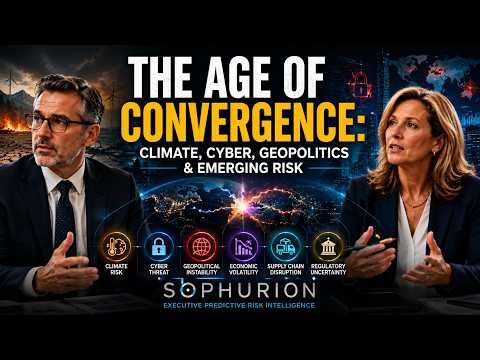
Can better intelligence improve investment decisions? In this Executive Intelligence Briefing, a Chief Investment Officer (CIO) and Chief Risk Officer (CRO) discuss how investors, asset managers, pension funds, insurance companies, sovereign wealth funds, and corporate boards are adapting to an increasingly complex risk landscape. The conversation explores why traditional financial metrics alone may no longer provide sufficient visibility into emerging threats and opportunities, and how Executive Predictive Risk Intelligence (EPRI) can help organizations better understand climate, geopolitical, cyber, supply chain, and regulatory risks. The discussion examines the future of investment intelligence and the growing importance of transforming information into actionable insight.
The Future of Investment Intelligence: Beyond Financial Metrics
For decades, investment decisions have largely been driven by financial statements, earnings reports, analyst research, economic indicators, and historical performance data. While these remain important, today's investment environment is increasingly influenced by factors that often exist outside traditional financial analysis.
Climate change is affecting infrastructure, insurance markets, agricultural production, and supply chains. Geopolitical tensions are reshaping trade routes, energy markets, and global economic stability. Cybersecurity incidents can disrupt operations and erase shareholder value in a matter of hours. Regulatory changes can rapidly alter market dynamics, while technological disruption continues to create both opportunities and risks across nearly every industry.
In this Executive Intelligence Briefing, a Chief Investment Officer and Chief Risk Officer examine how investors and institutions are navigating this new reality. The discussion highlights a growing challenge facing investment professionals: organizations have access to more information than ever before, yet decision-makers often struggle to identify which signals truly matter.
The conversation explores the distinction between information and intelligence. Data alone does not create better decisions. Effective decision-making requires context, prioritization, and an understanding of how multiple risks interact across complex systems. As risks become increasingly interconnected, investors must look beyond isolated indicators and develop a more comprehensive view of emerging threats and opportunities.
A central theme of the discussion is the concept of Executive Predictive Risk Intelligence (EPRI). Rather than focusing solely on historical performance, EPRI seeks to help organizations understand the broader forces that may influence future outcomes. By integrating climate, geopolitical, cyber, supply chain, operational, and regulatory considerations into a unified intelligence framework, decision-makers can gain greater visibility into potential vulnerabilities and areas of opportunity.
The discussion also examines how investment firms, pension funds, insurance companies, sovereign wealth funds, corporate boards, and ratings organizations increasingly require tools capable of analyzing risk from a systems perspective. In an environment characterized by uncertainty and rapid change, resilience is becoming just as important as growth.
Sophurion Horizon is designed to support this evolution by transforming organizational information into actionable intelligence. Rather than overwhelming leaders with more data, the goal is to provide meaningful insights that support strategic planning, risk management, and informed decision-making.
As markets become more complex and risks become more interconnected, organizations that can identify emerging signals, understand systemic relationships, and act on intelligence rather than information alone may be better positioned to protect value, strengthen resilience, and pursue long-term success.
The future of investment intelligence may not be about collecting more data—it may be about understanding what the data means before everyone else does.
Key Takeaways Traditional financial metrics provide only part of the investment picture. Climate, cyber, geopolitical, supply chain, and regulatory risks increasingly influence investment outcomes. Investors face an information overload challenge rather than a lack of data. Executive Predictive Risk Intelligence helps transform information into actionable insight. Portfolio resilience is becoming a critical component of long-term value creation. Organizations that better understand interconnected risks may gain a strategic advantage. Related Sophurion Capabilities Sophurion Horizon Executive Predictive Risk Intelligence (EPRI) Emerging Risk Monitoring Strategic Risk Assessments Executive Dashboards & Intelligence Reporting Climate, Cyber & Geopolitical Risk Analysis AI-Powered Decision Support Enterprise Risk Intelligence Learn More
Discover how Sophurion Horizon helps organizations transform information into actionable intelligence and navigate an increasingly complex risk environment.
Sophurion Horizon — Executive Predictive Risk Intelligence Transforming organizational information into actionable intelligence.
Related



Steven W. Pearce
Steven W. Pearce is the Founder & CEO of Sophurion and Creator of Predictive Sustainability Intelligence (PSI), with more than 14 years of experience in sustainability, resilience, strategic intelligence, and executive risk advisory.