
The Global Intelligence Gap: Why Leaders Need Better Intelligence
What happens when the complexity of modern risks begins to exceed our ability to understand them? In this Executive Intelligence Briefing, a former senior Intelligence Community executive and a technology investor specializing in national security innovation explore a growing challenge known as The Global Intelligence Gap. The discussion examines how information overload, converging risks, and accelerating technological change are creating new challenges for governments, businesses, investors, and critical infrastructure operators. The conversation explores the growing need for anticipatory intelligence, strategic warning, and Executive Predictive Risk Intelligence (EPRI) to help leaders transform information into actionable intelligence and make better decisions in an increasingly uncertain world.
The Global Intelligence Gap: Why Leaders Need Better Intelligence
For much of modern history, decision-makers have struggled with a common challenge: uncertainty. Yet today's leaders face a new reality. The problem is no longer a lack of information. The problem is an overwhelming abundance of it.
Organizations now have access to unprecedented amounts of data generated by sensors, satellites, financial markets, supply chains, social media platforms, government reporting systems, artificial intelligence applications, and countless other sources. Despite this explosion of information, strategic surprises continue to occur. Cyberattacks disrupt critical infrastructure. Geopolitical conflicts reshape global markets. Climate-related disasters impact economies and supply chains. Emerging technologies create both opportunity and disruption at a pace many institutions struggle to match.
This growing disconnect between the complexity of global risks and the ability of leaders to understand and act upon them is what many experts describe as The Global Intelligence Gap.
In this Executive Intelligence Briefing, a former senior Intelligence Community executive and a technology investor examine why organizations continue to miss important signals despite having access to more information than ever before. The discussion highlights a fundamental distinction between data, information, and intelligence. While data can reveal what is happening, intelligence seeks to explain why it is happening, what it means, and what leaders should do next.
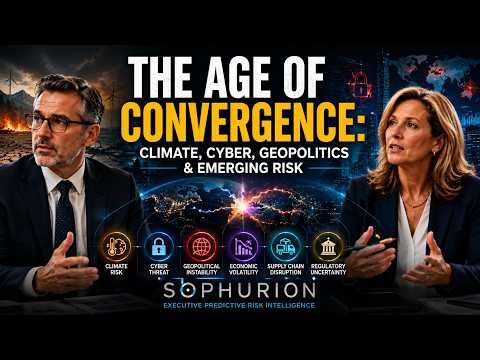
A central theme of the conversation is the emergence of what can be described as the Age of Convergence. Climate change, cyber threats, geopolitical instability, economic volatility, critical infrastructure vulnerabilities, supply chain disruptions, resource competition, and technological transformation are increasingly interconnected. These risks rarely occur in isolation. Instead, they interact in complex ways that can amplify uncertainty and create cascading consequences across organizations and societies.
The discussion explores why traditional dashboards, reports, and monitoring systems often struggle to provide meaningful foresight. Visibility alone does not create understanding. Organizations may successfully collect vast amounts of information while still failing to recognize emerging patterns or identify strategic risks before they become crises.
The participants also discuss the growing importance of anticipatory intelligence. Rather than focusing solely on historical analysis, leaders increasingly require tools capable of identifying emerging signals, monitoring changing conditions, and supporting strategic decision-making before disruptions occur. This shift represents a move from reactive risk management toward proactive intelligence and resilience.
Artificial intelligence is another key topic explored throughout the discussion. While AI offers significant opportunities for information synthesis, pattern recognition, and analytical support, the participants emphasize that technology alone is not the answer. Human judgment, contextual understanding, and strategic thinking remain essential. The future of intelligence is likely to involve collaboration between human expertise and advanced analytical systems rather than the replacement of one by the other.
The conversation introduces the concept of Executive Predictive Risk Intelligence (EPRI) as a framework for helping leaders better understand interconnected risks across climate, cyber, geopolitical, economic, operational, and infrastructure domains. By integrating diverse information sources into a coherent decision-support environment, organizations may be able to improve situational awareness, strengthen resilience, and make more informed decisions.
Sophurion Horizon is discussed as an example of how modern intelligence platforms can help transform organizational information into actionable intelligence. Rather than replacing analysts or decision-makers, such platforms are designed to support leaders by identifying emerging signals, monitoring interconnected risks, and providing greater visibility into complex operating environments.
As the pace of global change continues to accelerate, the ability to transform information into intelligence may become one of the most important competitive and strategic advantages available to governments, businesses, investors, and institutions. Organizations that can better understand complexity, identify emerging risks, and act before disruptions occur may be better positioned to navigate uncertainty and build resilience in the years ahead.
The Global Intelligence Gap is not simply a technology challenge. It is a leadership challenge, an organizational challenge, and increasingly, a strategic challenge that will shape the future of decision-making.
Key Takeaways Organizations face an information overload challenge rather than a data shortage. Climate, cyber, geopolitical, economic, infrastructure, and technological risks are increasingly interconnected. Strategic surprises often occur despite advances in data collection and analytics. Intelligence provides context, prioritization, and decision support beyond raw information. Anticipatory intelligence and strategic warning are becoming increasingly important. AI can enhance analysis but cannot replace human judgment and leadership. Executive Predictive Risk Intelligence (EPRI) offers a framework for understanding complex and interconnected risks. Resilience and decision advantage are emerging as critical strategic capabilities. Related Sophurion Capabilities Sophurion Horizon Executive Predictive Risk Intelligence (EPRI) Emerging Risk Monitoring Strategic Warning & Early Signal Detection Climate, Cyber & Geopolitical Risk Analysis Critical Infrastructure Intelligence Executive Decision Support Enterprise & Organizational Resilience Intelligence AI-Powered Intelligence Analysis Learn More
Sophurion Horizon helps organizations transform information into actionable intelligence through Executive Predictive Risk Intelligence, enabling leaders to better understand emerging risks, strengthen resilience, and make more informed decisions in an increasingly complex world.
Transforming organizational information into actionable intelligence.
Related



Steven W. Pearce
Steven W. Pearce is the Founder & CEO of Sophurion and Creator of Predictive Sustainability Intelligence (PSI), with more than 14 years of experience in sustainability, resilience, strategic intelligence, and executive risk advisory.