
Executive Predictive Risk Intelligence Explained
Executive Predictive Risk Intelligence transforms fragmented organizational information into actionable intelligence that helps leaders anticipate risks, strengthen resilience, and make better decisions in an increasingly complex world.
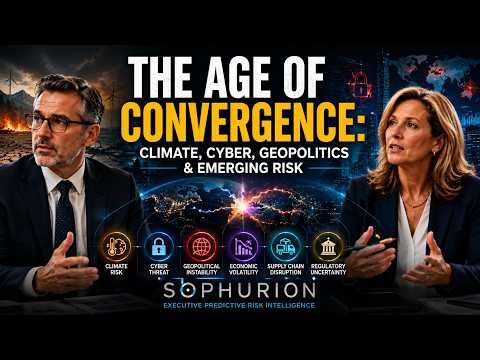
Organizations today operate in an environment defined by complexity, uncertainty, and accelerating change. Leaders must navigate geopolitical instability, economic volatility, technological disruption, cybersecurity threats, regulatory shifts, supply chain vulnerabilities, workforce challenges, and environmental pressures—all while continuing to pursue growth, innovation, and long-term resilience.
At the same time, organizations have access to more information than ever before.
The challenge is no longer obtaining data.
The challenge is understanding what it means.
This reality has given rise to a new requirement for modern leadership: Executive Predictive Risk Intelligence.
While the concept may sound complex, its purpose is straightforward. Executive Predictive Risk Intelligence is the process of transforming organizational information into actionable intelligence that helps leaders anticipate risks, strengthen resilience, and make better decisions.
It is designed to answer a question that many executives struggle with:
What should I be paying attention to before it becomes a problem?
Traditional reporting systems often focus on historical performance. Dashboards tell leaders what happened. Assessments describe current conditions. Compliance frameworks evaluate whether requirements have been met. While these tools remain valuable, they frequently provide a backward-looking perspective.
Executive Predictive Risk Intelligence is different.
Its objective is to help leaders identify emerging signals, understand potential implications, and support decision-making before risks escalate into disruptions.
In many organizations, critical information exists across multiple systems and departments. Finance teams monitor financial indicators. Operations teams track performance and supply chain conditions. Cybersecurity teams identify digital threats. Human resources monitors workforce trends. Sustainability teams evaluate environmental and regulatory developments. Sales teams gather market intelligence and customer insights.
Each function contributes valuable information.
However, executives are often left with a fragmented picture.
The challenge is not a lack of information. The challenge is integration.
Executive Predictive Risk Intelligence seeks to connect these information streams, identify meaningful relationships, and transform them into intelligence that supports leadership decision-making.
This distinction between information and intelligence is critical.
Information tells us what is happening.
Intelligence helps us understand why it matters.
More importantly, intelligence helps us determine what actions should be considered next.
For example, a traditional report may indicate increasing supply chain costs, growing regulatory pressure, and declining customer retention. Viewed independently, each issue appears manageable.
However, intelligence analysis may reveal that all three trends are connected to a broader strategic vulnerability. Rising costs may be affecting product pricing. Regulatory changes may be increasing operational burdens. Customer behavior may be shifting in response to market conditions.
What appears to be multiple separate issues may actually represent a single emerging risk.
This ability to identify relationships and implications is what distinguishes intelligence from information.
Executive Predictive Risk Intelligence is also inherently forward-looking.
The goal is not simply to understand the present. It is to anticipate potential futures.
This requires organizations to move beyond static assessments and embrace a more dynamic understanding of risk. Emerging threats rarely arrive without warning. They often produce signals long before they become crises. Market disruptions, geopolitical instability, workforce challenges, cybersecurity incidents, and environmental events frequently generate indicators that can be detected if organizations are looking in the right places.
The challenge is separating meaningful signals from background noise.
Leaders are exposed to an overwhelming volume of information every day. News headlines, market reports, performance metrics, regulatory developments, social media trends, and operational data all compete for attention. Not every signal deserves action.
Executive intelligence helps prioritize what matters most.
It enables leaders to focus resources on the risks and opportunities most likely to influence organizational performance.
Importantly, Executive Predictive Risk Intelligence is not about predicting the future with certainty.
No organization can eliminate uncertainty.
Instead, it is about improving preparedness.
Organizations that anticipate potential challenges earlier gain more options. They have more time to evaluate responses, allocate resources, engage stakeholders, and adapt strategies. In many cases, resilience is not determined by whether a disruption occurs but by how early leaders recognize it and how effectively they respond.
This is where executive intelligence becomes a strategic advantage.
Organizations that can identify emerging risks before competitors, recognize vulnerabilities before they become crises, and adapt before conditions deteriorate are better positioned to thrive in uncertain environments.
The benefits extend beyond risk management.
Executive Predictive Risk Intelligence can also help identify opportunities.
The same analytical processes used to detect threats can reveal emerging markets, evolving customer needs, technological innovations, operational efficiencies, and strategic advantages. Intelligence is not solely about avoiding problems. It is about improving decision-making across the organization.
As business environments become more interconnected, the need for executive intelligence will continue to grow.
The organizations that succeed in the coming decade will not necessarily be those with the most data. They will be those that can transform information into understanding, understanding into intelligence, and intelligence into action.
That is the foundation of Executive Predictive Risk Intelligence.
It is not another dashboard.
It is not another assessment.
It is not another reporting framework.
It is a decision-support capability designed to help leaders see what others miss, prepare for what others overlook, and act with greater confidence in an increasingly uncertain world.
In an era of information overload, intelligence becomes one of the most valuable strategic assets an organization can possess.
Related



Steven W. Pearce
Steven W. Pearce is the Founder & CEO of Sophurion and Creator of Predictive Sustainability Intelligence (PSI), with more than 14 years of experience in sustainability, resilience, strategic intelligence, and executive risk advisory.