
Five Emerging Risks Every Leadership Team Should Monitor
Geopolitical instability, artificial intelligence, climate volatility, cybersecurity threats, and workforce transformation are reshaping the operating environment for organizations worldwide. Understanding these interconnected risks is essential for leaders seeking to strengthen resilience, anticipate disruption, and make better strategic decisions in an increasingly uncertain world.
The world is entering a period of profound transformation. Economic uncertainty, geopolitical competition, technological disruption, climate volatility, demographic shifts, and evolving regulatory expectations are reshaping the operating environment for organizations across every sector. While risk has always been a fundamental component of business, the nature of risk itself is changing. The challenges facing leadership teams today are increasingly interconnected, dynamic, and difficult to assess through traditional management frameworks.
Many organizations continue to focus primarily on known risks and historical performance indicators. Yet some of the most significant threats to future organizational performance emerge gradually, often producing weak signals long before they become visible crises. By the time these risks appear on traditional dashboards, leadership teams may have already lost valuable time, flexibility, and strategic options.
The most resilient organizations are not necessarily those that avoid risk. They are the organizations that develop the ability to identify emerging challenges early, understand their potential implications, and adapt before disruption occurs. In an environment characterized by accelerating change, this capability is becoming a critical competitive advantage.
While every organization faces unique circumstances, several emerging risks deserve close attention from leadership teams over the coming years.
Geopolitical Fragmentation and the New Era of Strategic Competition
For decades, organizations benefited from a relatively stable global environment that supported expanding trade networks, increasingly efficient supply chains, and access to international markets. That environment is becoming more uncertain.
The rise of strategic competition among major powers, regional conflicts, trade restrictions, sanctions, resource nationalism, and growing concerns surrounding economic security are creating new pressures across global markets. Supply chains that once appeared optimized for efficiency are now being evaluated through the lens of resilience and security. Critical resources, manufacturing capabilities, technology supply chains, and strategic infrastructure are increasingly viewed as matters of national interest rather than purely commercial considerations.
Many organizations remain exposed to geopolitical risks they do not fully understand. Dependencies on specific suppliers, regions, transportation routes, or critical materials can create vulnerabilities that may not become apparent until disruption occurs. The challenge for leadership teams is no longer simply monitoring political developments. It is understanding how those developments may affect operations, customers, investments, and long-term strategy.
The organizations best positioned to navigate the coming decade will be those that recognize geopolitics as a business issue rather than a distant external concern.
Artificial Intelligence Governance and Strategic Risk
Artificial intelligence is rapidly becoming one of the most transformative technologies of our time. Organizations are integrating AI into operations, customer engagement, analytics, decision-making processes, and product development at an unprecedented pace. The opportunities are significant, but so are the risks.
Much of the current conversation surrounding artificial intelligence focuses on productivity and innovation. Far less attention is being paid to governance, accountability, and long-term organizational implications. Questions surrounding data integrity, model transparency, intellectual property, bias, cybersecurity, regulatory compliance, and human oversight remain unresolved in many organizations.
History has repeatedly demonstrated that technological adoption often outpaces governance. Artificial intelligence appears to be following a similar trajectory. Organizations eager to capitalize on competitive advantages may find themselves exposed to operational, legal, and reputational risks if appropriate safeguards are not established.
Leadership teams should view AI not merely as a technology initiative, but as a strategic governance challenge that requires ongoing oversight and clear accountability structures.
Climate Volatility and Systemic Disruption
Climate-related risks are often discussed within the context of sustainability, environmental reporting, or regulatory compliance. While these areas remain important, they represent only part of the broader challenge.
Climate volatility is increasingly becoming a business resilience issue.
Extreme weather events, prolonged droughts, heat stress, flooding, infrastructure vulnerabilities, water scarcity, and shifting insurance markets are already affecting organizations around the world. These impacts extend far beyond environmental departments. They influence supply chains, workforce productivity, facilities management, logistics, energy costs, investment decisions, and long-term operational planning.
The reality is that climate-related disruption is no longer a future concern. It is a present-day operational challenge with implications for virtually every sector of the economy.
Organizations that treat climate risk solely as a reporting obligation may overlook significant strategic vulnerabilities. Those that incorporate resilience planning into broader business strategy will likely be better positioned to adapt as conditions continue to evolve.
Cybersecurity and Expanding Digital Exposure
As organizations become increasingly dependent on digital infrastructure, cybersecurity risk continues to grow in both complexity and consequence.
The threat landscape has evolved far beyond isolated malware incidents or data breaches. Organizations now face ransomware campaigns, supply chain attacks, insider threats, state-sponsored cyber activity, operational technology vulnerabilities, and emerging risks associated with artificial intelligence and automation.
What makes cybersecurity particularly challenging is its interconnected nature. A successful attack can simultaneously affect operations, finances, customer relationships, regulatory compliance, and organizational reputation. In many cases, cyber incidents become business continuity events rather than purely technical issues.
Despite this reality, some organizations continue to view cybersecurity primarily as an IT responsibility. Increasingly, it is becoming a leadership responsibility.
Effective cybersecurity requires governance, strategic planning, workforce awareness, resilience measures, and executive engagement. Organizations that fail to recognize this shift may find themselves reacting to crises rather than preparing for them.
Workforce Transformation and Human Capital Resilience
Technology often dominates discussions regarding future disruption, yet one of the most significant risks facing organizations may be far more human in nature.
Workforce dynamics are changing rapidly. Demographic shifts, evolving employee expectations, leadership succession challenges, skills shortages, remote work models, and increasing competition for specialized talent are creating new pressures across industries.
Many organizations focus heavily on acquiring talent while dedicating far less attention to retaining institutional knowledge, developing future leaders, and strengthening organizational adaptability. Yet resilience ultimately depends on people.
A workforce capable of learning, adapting, innovating, and responding effectively to change may become one of the most important strategic assets an organization possesses.
As technology continues to reshape industries, organizations must think beyond recruitment and consider broader questions of workforce resilience. How quickly can employees adapt to new realities? How effectively can leaders manage uncertainty? How prepared is the organization for future workforce disruptions?
The answers to these questions will increasingly influence long-term performance.
Understanding the Connections
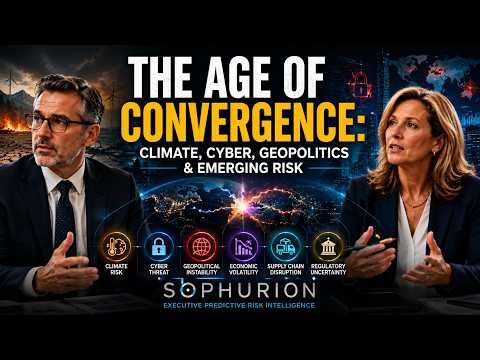
Perhaps the most important lesson for leadership teams is that these risks should not be viewed independently.
Geopolitical instability can affect supply chains. Supply chain disruptions can influence financial performance. Climate events can impact operations and workforce productivity. Cyber incidents can disrupt critical infrastructure. Artificial intelligence can reshape workforce requirements while introducing new governance challenges.
These risks interact with one another in ways that amplify uncertainty and create cascading effects across organizations.
This interconnectedness is precisely why traditional risk management approaches often struggle to provide executives with meaningful insight. Assessing risks individually may satisfy reporting requirements, but it rarely provides a complete understanding of organizational exposure.
Leadership teams must increasingly adopt a systems-based perspective that recognizes the relationships between risks rather than viewing them as isolated events.
Looking Ahead
The future will remain uncertain. New risks will emerge, existing risks will evolve, and unexpected events will continue to challenge organizations around the world.
The objective is not to predict every disruption.
The objective is to develop the capacity to identify emerging signals, understand potential implications, and make informed decisions before risks escalate into crises.
Organizations that invest in this capability will not eliminate uncertainty. They will, however, be better positioned to navigate it.
In a world defined by accelerating change, resilience is no longer simply about recovery. It is about anticipation. And the organizations that learn to anticipate emerging risks before others may ultimately possess one of the most valuable advantages of all.
Related



Steven W. Pearce
Steven W. Pearce is the Founder & CEO of Sophurion and Creator of Predictive Sustainability Intelligence (PSI), with more than 14 years of experience in sustainability, resilience, strategic intelligence, and executive risk advisory.