
The Executive Intelligence Gap: Why Leaders See Risks Too Late
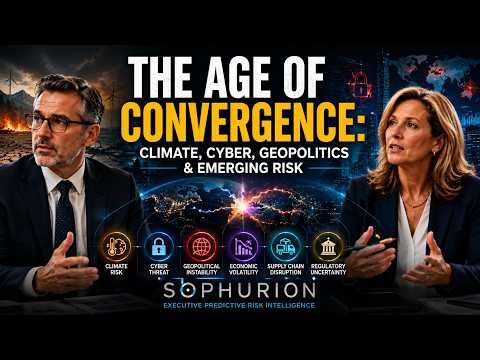
Organizations today have access to more information than ever before, yet many still struggle to identify emerging risks until it is too late. In this Sophurion Executive Intelligence Briefing, a Fortune 500 CEO and Chief Risk Officer discuss the growing complexity of climate, geopolitical, cyber, economic, and operational risks, and explore why organizations need actionable intelligence—not just more data—to make better decisions.
Why Leaders See Risks Too Late
Most organizations do not suffer from a lack of information. They suffer from a lack of intelligence.
As businesses operate in an increasingly interconnected world, leaders must navigate a growing convergence of risks that span climate change, geopolitical instability, cybersecurity threats, supply chain disruption, regulatory change, economic volatility, and technological transformation. While organizations collect vast amounts of data, many struggle to transform that information into meaningful insights that support executive decision-making.
In this Executive Intelligence Briefing, a Fortune 500 CEO and Chief Risk Officer explore one of the most important challenges facing modern organizations: why leaders often identify risks only after they have become crises.
The discussion examines the limitations of traditional risk management approaches, the growing complexity of interconnected risks, and the widening gap between information and actionable intelligence. It also explores how advances in artificial intelligence, predictive analytics, and executive decision-support systems are creating new opportunities for organizations to anticipate threats, strengthen resilience, and improve strategic decision-making.
The conversation introduces the concept of Executive Predictive Risk Intelligence and discusses how platforms such as Sophurion Horizon are being designed to help organizations move from reactive management to proactive leadership.
Key themes include:
The difference between information and intelligence Why emerging risks are increasingly difficult to identify The convergence of climate, geopolitical, cyber, and operational risks Organizational resilience in an age of uncertainty Executive decision-making and predictive intelligence The future of AI-powered risk management
As the pace of change accelerates, organizations that can identify weak signals earlier, understand emerging threats more clearly, and make better-informed decisions may gain a significant strategic advantage.
Watch the full Executive Intelligence Briefing above to explore how leaders can improve visibility, strengthen resilience, and prepare for an increasingly complex future.
Sophurion Horizon Executive Predictive Risk Intelligence
Transforming organizational information into actionable intelligence.
Related



Steven W. Pearce
Steven W. Pearce is the Founder & CEO of Sophurion and Creator of Predictive Sustainability Intelligence (PSI), with more than 14 years of experience in sustainability, resilience, strategic intelligence, and executive risk advisory.