
The Future of Executive Predictive Risk Intelligence
Organizations face growing complexity, interconnected risks, and unprecedented volumes of information. The future belongs to leaders who can transform information into intelligence, anticipate emerging challenges, strengthen resilience, and make better decisions through Executive Predictive Risk Intelligence.
Announcement
The world is becoming more complex.
That statement may sound obvious, but its implications for organizations are profound. Every year, leaders are expected to make decisions in an environment shaped by increasing uncertainty, accelerating technological change, geopolitical instability, climate volatility, cybersecurity threats, regulatory complexity, workforce transformation, and rapidly shifting market conditions.
At the same time, organizations are generating more information than ever before.
Dashboards continue to multiply. Reports become increasingly detailed. Data volumes expand. New technologies promise greater visibility and deeper analytics.
Yet despite this abundance of information, many leaders continue to struggle with the same challenge:
Understanding what matters most.
The issue is not a lack of data.
The issue is a lack of intelligence.
For too long, organizations have focused on collecting information rather than transforming it into actionable insight. As a result, leadership teams often find themselves overwhelmed by data while remaining uncertain about emerging risks, future disruptions, and strategic priorities.
This challenge is becoming one of the defining leadership issues of our time.
And it is precisely why I believe the future belongs to Executive Predictive Risk Intelligence.
Beyond Information
Traditional reporting systems were designed for a different era.
Most organizational tools tell leaders what happened. They summarize historical performance, measure compliance, track operational indicators, and provide visibility into current conditions. While these capabilities remain important, they are increasingly insufficient in a world where disruption can emerge rapidly and unexpectedly.
Leaders do not simply need information about the present.
They need intelligence about the future.
They need the ability to identify weak signals, understand emerging trends, recognize interconnected risks, evaluate potential consequences, and make informed decisions before disruption occurs.
This requires a fundamentally different approach.
Executive Predictive Risk Intelligence is not about generating more reports. It is about transforming information into intelligence that supports anticipation, preparedness, resilience, and strategic decision-making.
In many ways, the distinction is simple.
Information tells us what is happening.
Intelligence helps us understand why it matters and what should happen next.
The Rise of Interconnected Risk
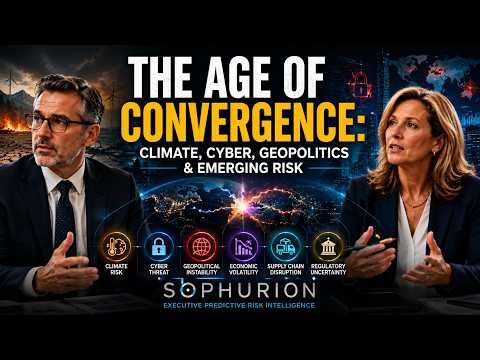
One of the defining characteristics of today's operating environment is that risks no longer exist in isolation.
Geopolitical instability influences supply chains.
Supply chain disruptions affect financial performance.
Climate events impact infrastructure and resource availability.
Cyber incidents disrupt operations and damage trust.
Artificial intelligence creates new opportunities while introducing governance challenges.
Workforce dynamics influence innovation, resilience, and organizational performance.
Each of these issues can influence the others in ways that are difficult to predict using traditional management approaches.
This interconnectedness is creating a growing need for intelligence capabilities that can identify relationships, evaluate implications, and help leadership teams understand the broader strategic picture.
The organizations that succeed in the coming decade will not necessarily be those with the most information.
They will be those that can make sense of complexity.
From Reactive to Predictive
Historically, many organizations have managed risk reactively.
An event occurs.
A disruption emerges.
A response is developed.
Lessons are learned.
Controls are implemented.
The cycle repeats.
While reactive capabilities remain necessary, they are no longer sufficient.
The future of organizational resilience will depend increasingly on the ability to anticipate challenges before they become crises.
Predictive intelligence does not eliminate uncertainty.
No model, platform, or framework can predict every future event.
However, predictive intelligence can improve preparedness by identifying emerging patterns, highlighting weak signals, monitoring evolving conditions, and helping leaders recognize risks earlier than they otherwise might.
The value lies not in certainty.
The value lies in foresight.
Organizations that identify risks earlier gain more time, more flexibility, and more strategic options.
In an increasingly uncertain world, those advantages matter.
Intelligence as a Strategic Capability
For decades, organizations invested heavily in operational systems, financial systems, customer relationship management platforms, and business intelligence tools.
The next evolution may be intelligence itself.
Executive Predictive Risk Intelligence represents a new category of organizational capability. It sits at the intersection of risk management, strategic planning, resilience, analytics, and decision support.
Its purpose is not merely to collect information.
Its purpose is to help leaders understand what deserves attention, what actions should be considered, and where future risks and opportunities may emerge.
As organizations face growing complexity, intelligence will become increasingly important as a strategic asset.
Much like cybersecurity evolved from a technical issue into a board-level priority, intelligence is likely to evolve from a specialized function into a core leadership capability.
The organizations that embrace this shift early may gain significant advantages in resilience, adaptability, and decision-making effectiveness.
Building the Future
At Sophurion, this vision drives everything we are building.
We believe the future of leadership requires more than dashboards, assessments, and reporting tools. It requires intelligence.
It requires systems capable of transforming organizational information into actionable insights that help leaders anticipate risks, strengthen resilience, identify opportunities, and make better decisions.
That vision is reflected in Sophurion Horizon and in our broader commitment to advancing Executive Predictive Risk Intelligence.
Our goal is not simply to help organizations understand where they stand today.
Our goal is to help them prepare for what comes next.
Looking Ahead
The future will belong to organizations that can navigate uncertainty with confidence.
It will belong to leaders who can recognize emerging risks before they become crises, identify opportunities before competitors, and make informed decisions despite increasingly complex conditions.
The challenge facing organizations is not a shortage of information.
The challenge is transforming information into intelligence.
That transformation is already underway.
And in the years ahead, Executive Predictive Risk Intelligence may become one of the most important capabilities an organization can possess.
The future of risk management is not simply about responding faster.
It is about anticipating better.
The future of resilience is not simply about recovery.
It is about preparedness.
And the future of leadership will increasingly depend on the ability to transform information into intelligence, intelligence into action, and action into strategic advantage.
Related



Steven W. Pearce
Steven W. Pearce is the Founder & CEO of Sophurion and Creator of Predictive Sustainability Intelligence (PSI), with more than 14 years of experience in sustainability, resilience, strategic intelligence, and executive risk advisory.