
Why Traditional Risk Assessments Fail Executives
Traditional risk assessments generate information, but executives need intelligence. Discover why fragmented, backward-looking assessments often fail decision-makers and why intelligence-driven approaches are becoming essential for organizational resilience and strategic success.
Organizations have never invested more resources into risk management. Across industries, leaders are inundated with assessments, audits, compliance reviews, maturity models, risk registers, scorecards, and reporting frameworks. Yet despite this growing investment, executives continue to find themselves surprised by disruptions that threaten operations, damage reputation, weaken financial performance, and undermine long-term resilience.
This raises an important question: if organizations are conducting more assessments than ever before, why do so many leaders still struggle to anticipate emerging risks?
The answer lies in a fundamental distinction that is often overlooked.
Most risk assessments generate information.
Executives need intelligence.
While information and intelligence are frequently used interchangeably, they serve very different purposes. Information describes conditions, observations, and data points. Intelligence provides context, identifies relationships, highlights significance, and supports decision-making. Information helps us understand what is happening. Intelligence helps us understand why it matters and what actions should be considered next.
Many traditional risk assessments excel at collecting information. Far fewer succeed at transforming that information into actionable executive intelligence.
One of the most common shortcomings is fragmentation. Risk assessments are often conducted within functional silos. Cybersecurity teams evaluate digital threats. Sustainability teams assess climate-related risks. Compliance departments focus on regulatory obligations. Operations teams examine supply chain vulnerabilities. Human resources reviews workforce challenges. Finance evaluates financial exposure. Each assessment may be technically sound, but executives are left with a collection of disconnected findings rather than an integrated understanding of organizational risk.
As a result, leaders receive multiple reports but rarely receive a unified picture.
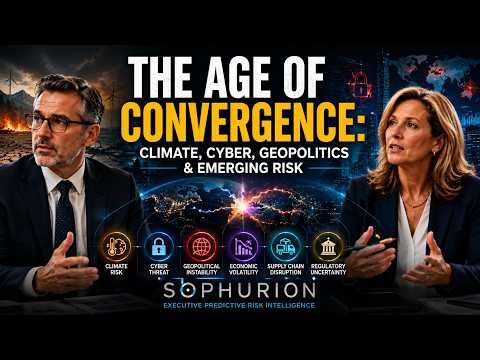
The challenge becomes even more significant in an increasingly interconnected world. Climate disruptions influence supply chains. Geopolitical instability affects energy markets. Cyber incidents create operational disruptions. Regulatory changes alter investment decisions. Workforce shortages impact resilience and growth. Risks that were once viewed independently now interact in ways that amplify uncertainty and create cascading effects across organizations.
Traditional assessment models frequently struggle to account for these interdependencies.
Another limitation is their tendency to focus on historical conditions rather than future developments. Many assessments provide a snapshot of the present or a review of past performance. While this information remains valuable, executives are ultimately responsible for navigating the future. Decisions regarding investments, workforce planning, market expansion, technology adoption, infrastructure, and resilience require an understanding of emerging risks, not simply existing conditions.
A risk assessment that explains what happened yesterday may satisfy compliance requirements. It may not help leadership prepare for what could happen tomorrow.
This distinction is becoming increasingly important as organizations operate in an environment characterized by accelerating change. Technological disruption, artificial intelligence, geopolitical competition, environmental pressures, regulatory evolution, and shifting stakeholder expectations are creating new forms of uncertainty that cannot always be measured through conventional approaches. Organizations that rely solely on static assessments may find themselves reacting to change rather than anticipating it.
Executives require a different perspective.
They need visibility into how risks interact. They need to understand which issues require immediate attention and which can be monitored over time. They need clarity regarding the potential consequences of inaction. Most importantly, they need intelligence that helps prioritize resources, inform strategy, and strengthen organizational resilience.
This is where many traditional assessments fall short.
A lengthy report filled with technical findings may satisfy auditors, regulators, or compliance teams. However, executives often have limited time and must make decisions across multiple competing priorities. They require concise, actionable insights that connect risk to organizational objectives. They need to know where exposure exists, how significant it may become, and what actions offer the greatest potential value.
In many cases, the challenge is not the quality of the assessment itself. The challenge is the absence of a mechanism that transforms assessment outputs into decision-support intelligence.
The organizations most likely to succeed in the coming decade will be those capable of moving beyond assessment-centric approaches toward intelligence-driven decision-making. This does not mean abandoning traditional assessments. It means recognizing that assessments represent the beginning of the process rather than the end.
The future of risk management lies in integrating information from multiple sources, identifying meaningful patterns, evaluating strategic implications, and providing leadership with actionable intelligence that supports proactive decision-making. Risk management must evolve from a compliance exercise into a strategic capability.
Organizations that make this transition will gain a significant advantage. They will be better positioned to anticipate disruption, allocate resources effectively, strengthen resilience, and identify opportunities that others may overlook. They will spend less time reacting to events and more time preparing for them.
Ultimately, executives do not need more reports.
They do not need more dashboards.
They do not need more disconnected metrics.
They need intelligence.
In a world defined by complexity, uncertainty, and rapid change, the organizations that can transform information into intelligence will be the organizations best positioned to lead.
Related



Steven W. Pearce
Steven W. Pearce is the Founder & CEO of Sophurion and Creator of Predictive Sustainability Intelligence (PSI), with more than 14 years of experience in sustainability, resilience, strategic intelligence, and executive risk advisory.